There are some emergencies that announce themselves. Hurricanes build for days on radar. Tornadoes trigger sirens. Floods rise gradually enough that you usually have some warning window to act. Earthquakes give you nothing. No forecast, no alert, no countdown. One moment everything is normal, and the next the ground beneath your feet is moving and there is absolutely nothing you can do to stop it.
That reality — the complete absence of warning — is what makes earthquake preparedness uniquely important and uniquely challenging. You cannot prepare in the moment. By definition, all of your preparation has to happen before the shaking starts. If you haven’t done it yet, now is the time.
I haven’t experienced an earthquake personally. But I’ve studied them carefully, I follow guidance from FEMA, the United States Geological Survey, and emergency management professionals who specialize in seismic events, and I’ve thought seriously about this threat as part of a comprehensive preparedness mindset. What I share here comes from that research and from the same principles that guide everything else on this site.
Earthquakes Are Not Just a West Coast Problem
The first thing I want to address is a misconception that keeps a lot of people from taking this seriously — the idea that earthquakes are a California problem, or a Pacific Northwest problem, and that if you don’t live in those places you don’t need to worry about it.
That is not accurate.
The New Madrid Seismic Zone — centered around the Missouri, Arkansas, Tennessee, and Kentucky region — is one of the most significant seismic hazard areas in the entire United States. The earthquakes that struck that zone in 1811 and 1812 were among the most powerful ever recorded in North American history. They rang church bells in Washington D.C. and were felt as far away as Canada.
The South Carolina coast has significant seismic history. The Pacific Northwest faces the Cascadia Subduction Zone — a fault capable of producing a magnitude 9.0 or greater earthquake that scientists consider overdue. Oklahoma has experienced a dramatic increase in seismic activity in recent decades. Alaska is one of the most seismically active places on earth.
Wherever you live in the United States, earthquake risk exists on some level. The degree varies, but dismissing it entirely based on geography is a mistake I’d encourage you to avoid.
What Makes Earthquakes So Dangerous
Understanding the specific threats posed by earthquakes helps clarify what you’re actually preparing for. It’s not just the shaking itself — it’s everything the shaking triggers.
Structural collapse is the most dramatic danger — buildings, bridges, and overpasses that fail under seismic stress. Modern building codes in high-risk areas are designed to reduce this risk, but older structures, poorly constructed buildings, and infrastructure that hasn’t been retrofitted remain vulnerable.
Falling objects inside your home are responsible for a significant portion of earthquake injuries. Unsecured bookshelves, televisions, water heaters, cabinets, and overhead fixtures become dangerous projectiles when the ground moves. Most earthquake injuries don’t come from the building collapsing — they come from objects falling on people inside.
Fire is one of the most historically significant secondary dangers of major earthquakes. Gas lines rupture, electrical systems spark, and fires start simultaneously across a wide area at a moment when water mains may also be broken and fire departments are overwhelmed. The fires that followed the 1906 San Francisco earthquake caused more destruction than the earthquake itself.
Tsunamis are triggered by underwater earthquakes and can devastate coastal areas with almost no warning. If you live near the coast and feel a significant earthquake, move to high ground immediately without waiting for an official warning.
Aftershocks follow major earthquakes — sometimes for days or weeks, sometimes nearly as powerful as the original event. Buildings weakened by the initial quake can collapse during aftershocks. Assume aftershocks are coming and plan accordingly.
Infrastructure disruption — broken water mains, damaged roads, downed power lines, overwhelmed emergency services — means the aftermath of a major earthquake can feel like a grid-down scenario that lasts for an extended period. Self-sufficiency in the immediate aftermath is not optional. It’s necessary.
What to Do Before an Earthquake
Because earthquakes provide no warning, before is the only time you have to prepare. Here’s what I recommend.
Secure your home’s interior. Walk through every room and think about what would fall, tip over, or become a projectile in a violent shaking event. Anchor tall bookshelves and furniture to wall studs. Secure your water heater — which is both a fall risk and a gas leak risk — with straps designed for that purpose. Use museum putty or cabinet latches to keep dishes and collectibles from becoming projectiles. Move heavy items from high shelves to lower ones. This single step prevents a significant percentage of earthquake injuries.
Know how to shut off your gas. A gas leak after an earthquake is a serious fire and explosion risk. Find your gas meter and make sure you know how to shut it off. Keep an appropriate wrench accessible nearby — not in a toolbox across the garage, but right there. Make sure every adult in your household knows how to do this.
Identify safe spots in every room. The old advice to stand in a doorway is largely outdated — modern doorframes offer little structural advantage. Current guidance from FEMA and seismic experts recommends the Drop, Cover, and Hold On approach. Get down on your hands and knees, take cover under a sturdy table or desk if one is nearby, and hold on. If there’s no table, get against an interior wall away from windows and cover your head and neck with your arms. Identify these spots in every room now, before you need them.
Prepare for extended self-sufficiency. A major earthquake can disrupt water, power, gas, and road access simultaneously and for an extended period. Your emergency kit needs to reflect that reality. I recommend a minimum of two weeks of water and food storage for a serious seismic event — more than the 72-hour standard I recommend for shorter-duration emergencies. Water is particularly important since broken mains can leave communities without running water for days or weeks.
Have your emergency kit ready and accessible. Your bug out bag and home emergency supplies should be stored where you can access them even if doors have swollen shut or debris has blocked certain areas. Consider keeping a pair of sturdy shoes and a flashlight under your bed — the most common time to experience an earthquake is when you’re asleep, and broken glass on the floor in the dark is a serious hazard.
Reinforce your home if possible. If you live in a high-risk seismic area, consult a structural engineer about retrofitting options — particularly for older homes built before modern seismic codes. Bolting your home to its foundation and reinforcing cripple walls are among the most effective structural improvements available.
Make a family communication plan. Designate an out-of-area contact that all family members can check in with, since local phone lines may be overwhelmed or damaged. Establish a meeting point for your family in case you’re separated. Make sure your children’s school has your current emergency contact information and that you understand their earthquake reunification procedures.
What to Do During an Earthquake
When the shaking starts, you have seconds to act. There is no time to think through a plan in that moment — your response needs to be automatic, which is why practicing it matters.
If you’re indoors: Drop, Cover, and Hold On. Get down on your hands and knees immediately. Get under a sturdy table or desk if one is within reach. If not, move against an interior wall away from windows and cover your head and neck with your arms. Stay in place until the shaking stops. Do not run outside during shaking — most injuries occur when people try to move during the earthquake and are struck by falling objects.
If you’re outdoors: Move away from buildings, streetlights, and utility wires. Once you’re in the open, drop to your hands and knees and stay there until the shaking stops. The greatest danger outdoors is falling debris from buildings.
If you’re in a vehicle: Pull over safely away from buildings, trees, overpasses, and power lines. Stay inside with your seatbelt fastened until the shaking stops. Proceed carefully after the shaking ends, watching for road damage, downed lines, and debris.
If you’re near the coast: If you feel a significant earthquake and you are near the ocean, move to high ground immediately. Do not wait for an official tsunami warning. The earthquake itself is your warning.
What to Do After an Earthquake
The shaking stopping does not mean the danger is over. The immediate aftermath of a major earthquake carries its own serious risks.
Check yourself and others for injuries before doing anything else. Provide first aid as needed. Do not move seriously injured people unless they are in immediate danger.
Expect aftershocks. They will come. Some may be significant. Every time you feel aftershocks, Drop, Cover, and Hold On again. Do not assume the worst is over.
Check for hazards before moving through your home. Smell for gas. Look for sparks, broken wires, and structural damage. If you smell gas, leave immediately, leave the door open behind you, and don’t operate any electrical switches. Call your gas company from outside or from a neighbor’s home.
Do not use open flames. Gas leaks may be present even if you can’t smell them. Use flashlights rather than candles or matches until you’ve confirmed there’s no gas leak.
Check your water supply. Assume tap water may be contaminated after a major earthquake until authorities confirm it’s safe. Use your stored water supply and treat any water from alternative sources.
Stay off the roads if possible. Emergency vehicles need clear access. Roads may be damaged in ways that aren’t immediately visible. If you must drive, proceed carefully and be prepared to turn around.
Monitor emergency broadcasts. A battery-powered or hand-crank weather radio keeps you informed when cell service and power are disrupted. This is one of the most important pieces of equipment in any emergency kit and earthquakes are no exception.
Document damage for insurance purposes. Once it’s safe to do so, photograph all damage to your home and property before beginning any cleanup. This documentation matters significantly when filing insurance claims.
Your Earthquake Emergency Kit
The core of any good earthquake kit is the same as any other emergency kit — water, food, first aid, light, communication, and power. But earthquake preparedness has a few specific additions worth highlighting.
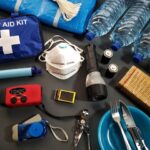
A minimum two-week water supply — one gallon per person per day. Non-perishable food for the same period. A quality first aid kit including supplies for treating cuts from broken glass. Sturdy work gloves for handling debris. Sturdy closed-toe shoes stored near your bed. A flashlight or headlamp stored where you can find it in the dark — also near your bed. A battery-powered or hand-crank weather radio. A wrench for shutting off gas stored near your gas meter. A fire extinguisher. Cash. Copies of important documents in a waterproof container. A whistle to signal for help if you become trapped under debris.
A Final Word
Earthquakes are the emergency that humbles me most as a preparedness advocate. Every other threat I cover gives you at least some warning — a forecast, a watch, a rising water level, a news report. Earthquakes give you nothing except the preparation you did in advance.
That’s either a sobering thought or a motivating one, depending on how you look at it. I choose to find it motivating. Because unlike the earthquake itself, your preparation is entirely within your control. You can do it today. You can make your home safer, your family more capable, and your recovery faster — all before a single tremor occurs.
Do it now. Not someday. Now.
Stay ready.
Note: Some links in this post are affiliate links. If you purchase through them, I may earn a small commission at no extra cost to you. I only recommend gear I actually believe in.