If you’ve spent in the South, you already know — tornado season is not a theory. It’s a reality. I’ve been through enough storms over the past ten years to know that the difference between a scary night and a genuinely dangerous one almost always comes down to one thing: how prepared you were before the sirens went off.
I’m not a meteorologist or an emergency management professional. I’m a husband and a dad who decided a long time ago that I wasn’t going to leave my family’s safety to chance. Everything I share here comes from personal experience, from studying real events, and from resources I trust — including FEMA and the Red Cross. Take what’s useful and make it your own.
Tornadoes Are Deadly — But They Usually Come With a Warning
The movie Twister made tornadoes look like they materialize out of nowhere. In reality, you almost always have some advance notice if you’re paying attention. NOAA estimates roughly 1,200 tornadoes touch down in the United States every year, causing an average of 70 deaths and 1,500 injuries. Most of those casualties involve people who either didn’t receive a warning or didn’t take it seriously.
I take them seriously. Every time.
The dangers are real and varied — violent winds that can exceed 200 mph, flying debris that can turn a lawn chair into a missile, flash flooding from the accompanying storms, downed power lines, ruptured gas lines, and fires. Tornadoes are indiscriminate and fast. But they are not unbeatable. Preparation is how you beat them.
What I Actually Do Before a Tornado
Here’s where I want to be specific, because generic advice only goes so far. This is my actual routine when a tornado threat is in the forecast.
I start with the weather forecast — days in advance. This is the most underrated preparedness step there is. Very often, severe weather doesn’t just appear. Meteorologists will flag the potential for severe storms 24 to 48 hours out. I check the forecast regularly during storm season, and when I see a significant threat on the horizon, I start preparing then — not when the sirens go off.
I secure everything outside. Patio furniture, grills, planters, kids’ toys — anything that wind can grab and turn into a projectile gets moved into the garage or tied down. This protects not just my property, but my neighbors’ too.
I clean and prep the bathtubs. This one surprises people, but it’s become a habit for me before any serious storm. If we lose water service in the aftermath, a bathtub full of clean water becomes an incredibly valuable resource for drinking, sanitation, and cooking. It costs you nothing and takes five minutes.
I do a full communications check. Before a storm hits, I make sure I have multiple ways to receive information and call for help. My go-to setup includes candles, lighters, and matches for light if we lose power; multiple flashlights with fresh batteries; and both a battery-powered and a hand-crank weather radio so I’m never dependent on a single power source. I also intentionally charge both of my cell phones to 100% before the storm arrives. When the power goes out — and it often does — a fully charged phone is a lifeline.
I make sure my recovery gear is accessible. In my garage I keep a heavy-duty tarp and a chainsaw. The tarp is there in case we take significant roof damage — you can cover a compromised roof quickly to prevent water intrusion while you wait for repairs. The chainsaw matters for a different reason: if a tree comes down across your driveway or the road out of your neighborhood, you need to be able to clear it yourself if evacuation becomes necessary. Don’t count on someone else to come clear your path.
Where to Take Shelter
When the warning is issued, where you go matters enormously.
At home, your safest option is a basement or an underground storm shelter. If you don’t have either — and most homes in Tennessee don’t have basements — go to the lowest floor, to an interior room away from all windows. A bathroom, a closet, a hallway. Put as many walls between you and the outside as possible. Get low, cover your head, and protect your neck.
I’d recommend having a helmet — even a bicycle helmet — stored in your shelter spot. Flying debris is what kills people in tornadoes, and protecting your head costs almost nothing.
If you’re at the office when a warning is issued, know your building’s emergency plan before you need it. Identify the interior safe zones on lower floors in advance. Don’t assume someone will tell you where to go in the moment — know it yourself.
If you’re in a car, your situation is more dangerous. A vehicle offers almost no protection against a strong tornado. If you can safely drive away from the tornado’s path — perpendicular to its direction of travel — do it. If you cannot outrun it, get out of the car and get into a low-lying ditch, covering your head. Never shelter under an overpass. Despite what you may have seen, overpasses funnel and accelerate wind, making them more dangerous, not less.
My Emergency Kit — What’s Actually In It
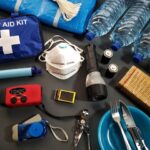
A good tornado kit doesn’t have to be elaborate. It has to be stocked, accessible, and checked regularly. Here’s what I keep ready:
Water is the foundation. Plan for at least one gallon per person per day for a minimum of three days. This is in addition to the bathtub water strategy — stored water in jugs or containers is for drinking; bathtub water is your backup for everything else.
Food should be non-perishable and easy to prepare without power. Canned goods, protein bars, dried fruit, peanut butter. Keep a manual can opener in the kit — you’ll feel foolish without one.
A first aid kit that’s actually stocked. Bandages, gauze, antiseptic, pain relievers, and any prescription medications your family depends on. Check expiration dates at least once a year.
Flashlights and extra batteries. I keep multiple around the house, not just one in a kit. You want to be able to find one in the dark.
A weather radio — battery-powered or hand-crank. Your phone is great, but if cell towers go down or your battery dies, a weather radio keeps you connected to emergency broadcasts. I consider this essential, not optional.
Backup power. A gasoline generator or a solar-powered station like a Jackery can keep your phones charged, your lights running, and critical medical equipment operational after an extended outage. This is one of the best investments I’ve made.
Cash and documents. Keep some cash on hand — ATMs don’t work without power. Store copies of insurance policies, IDs, and important contacts in a waterproof bag or container.
Tools. A wrench to shut off utilities, duct tape, a multi-tool or knife, and a fire extinguisher. A whistle is worth throwing in too — if you’re trapped under debris, a whistle carries farther than your voice.
What Happened to Us
I’ll be honest with you. We’ve come through tornado events in Nashville with what I’d call minor damage — some tree damage and roof damage that needed repair. It wasn’t catastrophic. But I genuinely believe the reason it stayed minor for us is that we didn’t wait for the storm to start preparing.
The tarp I had in the garage was ready if we’d needed it. The chainsaw was ready if we’d needed to clear a path out. The phones were charged. The radio was on. We knew where we were going the moment the sirens sounded. That preparation didn’t prevent the storm — but it meant we came out the other side without scrambling.
That’s the goal. Not to be fearless, but to be ready.
A Few Final Things
Conduct tornado drills with your family, especially if you have kids. Everyone should know where to go without being told. Run through it once before storm season hits.
Check your kit every six months. Rotate food and water. Replace dead batteries. Make sure the flashlights actually work.
And pay attention to the forecast. That’s where it all starts.
Tornadoes don’t have to be catastrophic for your family. With the right preparation, they can be something you survive, recover from, and learn from. That’s what this site is all about.
Stay ready.
Note: Some links in this post are affiliate links. If you purchase through them, I may earn a small commission at no extra cost to you. I only recommend gear I actually believe in.