I want to be straightforward with you at the start of this post: this is the topic I approached most carefully in building out this site. Not because it’s the most likely emergency you’ll ever face — it isn’t. But because it’s the one where the gap between prepared and unprepared is most stark, and where the information most people have is either dangerously wrong or completely absent.
Most of what the average person knows about nuclear attacks comes from movies. And movies get almost everything wrong.
The reality is more nuanced, more survivable, and more actionable than popular culture suggests. A nuclear event is not automatically a death sentence for everyone in the affected region. The decisions you make in the first few minutes and hours after a nuclear detonation have an enormous impact on your survival odds. And those decisions need to be made correctly and quickly — which means you need to understand them now, not in the moment.
I haven’t experienced a nuclear event. Nobody alive today in the United States has experienced one on home soil. But I’ve studied this topic carefully, drawing on guidance from FEMA, the Department of Homeland Security, and nuclear preparedness experts, and I’ve built my family’s preparedness plan to account for it. What I share here reflects that research and the same honest, practical approach I bring to every topic on this site.
The Realistic Nuclear Threat Landscape
Before we talk about preparation, it’s worth being clear about what the actual threat looks like in the modern world — because understanding the threat shapes the preparation.
Improvised nuclear device. The scenario considered most likely by national security experts is not a full-scale nuclear war — it’s a terrorist group obtaining and detonating a crude nuclear device in a major city. Such a device would be far less powerful than modern military nuclear weapons, but would still cause catastrophic damage within a defined radius and would create a significant fallout risk across a broader area.
Limited nuclear exchange. A limited exchange between nuclear-armed nations — involving a small number of weapons rather than a full arsenal — is considered a more credible near-term scenario than all-out nuclear war by many defense analysts.
Full scale nuclear war. The scenario most people picture when they think of nuclear attack — massive exchanges between superpowers targeting cities and infrastructure across the country simultaneously. This remains the least likely scenario but the most catastrophic.
For preparedness purposes, the improvised device and limited exchange scenarios are the most actionable — they’re survivable with the right response, and the preparation is identical regardless of which scenario occurs.
The Three Killers — And What You Can Do About Each One
A nuclear detonation kills and injures people through three primary mechanisms. Understanding each one is the foundation of effective nuclear preparedness.
The blast. The immediate explosive force of a nuclear detonation destroys everything within a certain radius — a radius that varies significantly based on the size of the weapon. Within the immediate blast zone, survival is not possible. Beyond that zone, the blast wave causes injuries and structural damage at decreasing severity with distance. If you are far enough from the detonation to survive the initial blast, your focus immediately shifts to the other two threats.
Thermal radiation. The intense heat and light released by a nuclear detonation can cause severe burns and ignite fires at significant distances from the blast. Looking directly at a nuclear detonation — even from many miles away — can cause permanent blindness. If you see a sudden, intense flash of light, turn away immediately and take cover. Do not look toward the source.
Nuclear fallout. This is the threat that most people misunderstand and that preparation most directly addresses. Fallout is the radioactive particles — primarily pulverized ground material that has been irradiated — that are carried into the atmosphere by the explosion and then fall back to earth downwind of the detonation. Fallout can be carried by wind for hundreds of miles and can arrive in areas that experienced no direct blast or thermal effects whatsoever.
Fallout is the threat that makes nuclear preparedness relevant to people who don’t live near obvious primary targets. And fallout is the threat that sheltering in place most directly and effectively addresses.
The Most Important Thing You Need to Know: Get Inside, Stay Inside, Stay Tuned
FEMA’s guidance for nuclear preparedness can be summarized in six words: Get Inside. Stay Inside. Stay Tuned.
These six words represent the most evidence-based, most life-saving guidance available for surviving a nuclear event outside the immediate blast zone. Let me explain each one.
Get Inside. The material between you and fallout particles dramatically reduces your radiation exposure. Not all shelter is equal — the more mass between you and the outside, the better your protection. A brick or concrete building provides far better protection than a wood-frame house. The center of a large building on a middle floor provides better protection than the edges. A basement provides better protection than upper floors. The goal is to put as much dense material between yourself and fallout as possible.
Getting inside needs to happen fast. Fallout from a nuclear detonation can begin arriving within fifteen minutes for areas close to the blast, and within hours for areas further away. Every minute you spend outside after a detonation in your region is a minute of potential fallout exposure. Move immediately and move with purpose.
Stay Inside. Once you’re sheltered, stay there. The radioactivity of fallout decreases rapidly over time — a principle captured in the rule of sevens, which holds that for every sevenfold increase in time after the detonation, radiation levels decrease by a factor of ten. Radiation that is intensely dangerous in the first hour is significantly reduced by seven hours, and dramatically reduced by 49 hours. Staying sheltered for the first 24 to 48 hours after a detonation provides enormous protective benefit. Official guidance recommends sheltering for a minimum of 24 hours and ideally until authorities provide guidance on when it’s safe to move.
Stay Tuned. A battery-powered or hand-crank weather radio — which I recommend for every emergency scenario on this site — is your lifeline for official guidance during a nuclear event. Authorities will provide information about the detonation location, wind direction, fallout patterns, and when it’s safe to evacuate or emerge from shelter. You need to be able to receive that information. Keep your radio in your shelter kit.
Immediate Actions After a Nuclear Detonation
If you see a flash or receive a warning that a nuclear detonation has occurred in your region, these are your immediate priorities in order.
If you are outside, get inside immediately. Do not stop to gather belongings. Do not get in your car and try to drive away — traffic will be gridlocked and you may be caught outside when fallout arrives. Get into the nearest substantial building, move to the center, move to a lower floor or basement if available, and stay away from windows and exterior walls.
If you are in a car, do not try to outrun fallout. Get out of the car and get into a nearby building. A car provides almost no protection against fallout radiation.
If you are already inside, stay inside. Move to the most protected area of the building — interior rooms, lower floors, basement. Close all windows, doors, and fireplace dampers. Turn off fans, air conditioning, and ventilation systems that draw outside air in. This reduces the amount of fallout particles that enter your shelter.
Remove and bag your outer clothing. If you were outside at the time of the detonation or in the immediate aftermath, removing your outer clothing before entering your shelter removes approximately 80 percent of external contamination. Place the clothing in a plastic bag, seal it, and keep it away from people. Shower with soap and water if possible — do not scrub, and wash your hair with shampoo rather than conditioner, which can bind radioactive particles to hair.
Do not eat or drink anything that may have been exposed to fallout. Use your stored water and food supply. Do not consume tap water until authorities confirm it is safe.
Potassium Iodide: What It Does and Doesn’t Do
Potassium iodide — KI — is a medication that protects the thyroid gland specifically from radioactive iodine, which is one component of nuclear fallout. It works by saturating the thyroid with stable iodine so that it cannot absorb the radioactive form.
I want to be very clear about what KI does and does not do, because there is widespread misunderstanding.
KI protects only the thyroid gland from only radioactive iodine. It provides no protection against other forms of radiation, other radioactive particles, or the blast and thermal effects of a nuclear detonation. It is not a general radiation antidote. It is one specific protective tool for one specific threat.
KI is available over the counter and is worth having in your emergency kit if you live in a region with nuclear power plants — which is the primary scenario where radioactive iodine release is a significant concern. For a nuclear weapon detonation, it is less central to your protection than sheltering, which addresses a much broader range of radiation exposure.
If you obtain KI, store it and understand its proper dosage and timing guidelines before you need it. It is only effective when taken at the right time relative to exposure.
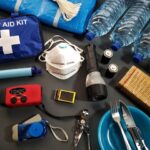
Your Nuclear Preparedness Kit
The core of nuclear preparedness is identical to preparedness for any extended shelter-in-place scenario. The specific additions are minimal.
Water. A minimum two-week supply of stored water per person. Municipal water supplies may be compromised following a nuclear event and tap water should not be consumed until authorities confirm safety.
Food. A minimum two-week supply of stored non-perishable food. Same rationale as water — do not consume food that may have been exposed to fallout.
A battery-powered or hand-crank weather radio. Non-negotiable for receiving official guidance during and after the event.
Plastic sheeting and duct tape. For sealing windows, doors, and vents to reduce fallout particle infiltration into your shelter space. Pre-cut to size and store with duct tape in an accessible location.
N95 or higher respirator masks. If you must be outside briefly — moving between buildings, for example — a respirator reduces inhalation of fallout particles. It is not a substitute for sheltering but provides meaningful protection for unavoidable brief outdoor exposure.
Potassium iodide. Worth having, particularly if you live near a nuclear power facility. Understand proper usage before you need it.
Radiation dosimeter or Geiger counter. Not essential for basic preparedness but valuable for knowing when radiation levels have dropped to safer levels if official guidance is unavailable. Basic radiation detection devices are available at a range of price points.
First aid kit and medications. Standard emergency kit contents apply. Ensure a sufficient supply of any prescription medications, since pharmacy access may be unavailable for an extended period.
Battery banks and lighting. Power will be out. Maintain your ability to charge devices and provide light without grid power.
Cash. Electronic payment systems will be down. Cash is the only reliable medium of exchange in the immediate aftermath.
A Note on Perspective
Nuclear preparedness sits at an uncomfortable intersection of real threat and paralyzing fear. I’ve noticed that some people respond to this topic by dismissing it entirely — “if it happens we’re all dead anyway” — and others by catastrophizing in ways that aren’t productive.
Both responses miss the point.
The reality is that nuclear preparedness — particularly for fallout survival — is practical, actionable, and genuinely life-saving in scenarios that are survivable for the vast majority of people outside the immediate blast zone. The six words Get Inside, Stay Inside, Stay Tuned represent guidance that could save millions of lives if people actually knew and followed them.
You’re not preparing for the end of the world. You’re preparing for a survivable emergency that requires specific, time-sensitive actions. That’s entirely consistent with everything else on this site.
Know what to do. Have what you need. Make the decisions now so you don’t have to make them in the moment.
Stay ready.
Note: Some links in this post are affiliate links. If you purchase through them, I may earn a small commission at no extra cost to you. I only recommend gear I actually believe in.